
Danny was professional and did an exceptional job.
I could not be more pleased with the results.
Colony Insulation installs spray foam insulation for homes and buildings in Clay and surrounding Southeast Michigan. When a structure has too many gaps, cracks, and hard-to-seal transitions, regular insulation alone does not always do enough. Spray foam insulation helps seal those weak spots, reduce energy loss, and improve the way the building handles heat, air, and moisture. This matters in attics, wall cavities, rim areas, crawl spaces, and other parts of a house or building where air movement never really stops. If the goal is better comfort, stronger thermal resistance, and fewer performance issues tied to air leakage, spray foam insulation is often the right answer.

Fill out the form below to get started on your project today!

Spray foam insulation does two jobs at once. It adds insulation, and it helps seal the openings that let outside air move in and conditioned air move out. That combination is what makes spray foam so effective in places where heat flow, air infiltration, and air leakage are driving up energy costs.
A lot of buildings do not just lose heat through thin insulation. They lose performance through small gaps around framing, plumbing, pipes, doors, windows, ceilings, and roof transitions. Spray foam insulation expands during the application process, filling those gaps and helping create a tighter building envelope.
Danny was professional and did an exceptional job.
I could not be more pleased with the results.
The foam is sprayed flawlessly.
Danny did an excellent job, and I would recommend Colony for spray foam insulation work.
Clean, quick, professional, and on time.
Danny answered all of my questions with confidence and did excellent work. One of the best installers I have seen.
My first floor struggled to make it above 60 degrees—now it’s 72 degrees and the floors are nice and warm.
Danny and his partner did an awesome job encapsulating my crawl space. They cleaned it out thoroughly, and the finished work exceeded my expectations.
Completed everything exactly as promised.
Colony Insulation was able to insulate our attic just one day after we signed the contract. The work was great, and they left the space neat and clean.
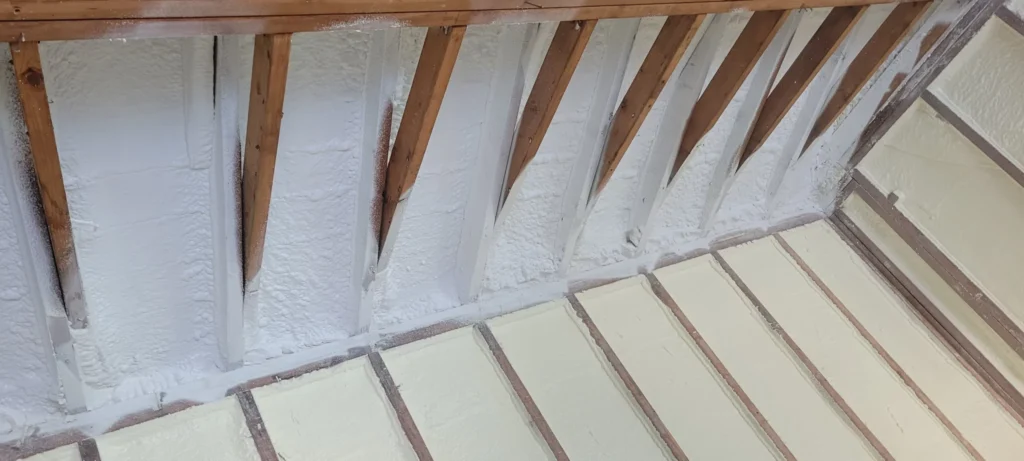
Spray foam is not for every single insulation job, but it is extremely useful in the right places. We often recommend spray foam insulation when standard materials are not enough to seal air leaks, when wall cavities are awkward, or when the structure has too many holes, cracks, and transitions for batt products to handle well.
Common areas include:
When those areas are left open, heat loss and air movement keep happening no matter how much other insulation gets added nearby.

Ira Township
Fort Gratiot
China Township
See how Colony Insulation can help bring your property higher energy efficiency and comfort.
One of the first questions people ask is whether they need open cell foam or closed cell spray foam. The answer depends on the structure, the moisture conditions, the location in the building, and what the insulation needs to do.
Open cell foam has a softer open cell structure and expands more aggressively during installation. That makes open cell foam useful for filling wall cavities, certain interior assemblies, and areas where the goal is broad filling and air sealing without the density of closed cell foam.
Open cell spray foam can help reduce noise, improve comfort, and seal air leaks in the right applications. Because of its open cell structure, it behaves differently around moisture and vapor than closed cell products do, so location matters.
Closed cell spray foam is denser, harder, and delivers a higher r value per inch than open cell foam. Closed cell foam is often used where moisture resistance, added rigidity, and strong thermal resistance matter more. It is common in crawl spaces, rim areas, roof transitions, exterior-facing assemblies, and places where space is limited but performance needs to stay high.
Closed cell spray foam also works well near a sill plate, along foundation transitions, and in areas where a stronger air barrier is important. When people want the most performance in the least amount of space, closed cell spray foam is usually what they are asking about.
R value matters, and spray foam insulation brings strong r value performance. Closed cell spray foam gives a higher r value per inch, while open cell foam still offers solid performance with different expansion and filling behavior. But foam insulation is not just about chasing numbers.
What makes spray foam valuable is the way it helps control air movement. If a building has leaks around pipes, plumbing, electrical runs, roof transitions, and framing joints, heat flow keeps happening even when other insulation is present. Foam insulation helps seal those problem areas so the building can perform the way it should.
That is why foam insulation often helps reduce energy bills and cooling bills in a way people actually notice. Less uncontrolled air movement means less wasted heating and cooling.
Colony Insulation installs spray foam insulation in the places where gaps and air leaks usually do the most damage.
Attic spaces are one of the most common places for spray foam. If the attic has roof transitions, exposed framing, awkward holes, and too many leaks, spray foam can help create a much tighter assembly. Spray foam insulation in an attic can reduce air infiltration, improve thermal resistance, and help stop heat from escaping in winter or building up in summer.
Spray foam is also useful in walls, especially when wall cavities are irregular or hard to seal with other materials. Whether the project is new construction or upgrading existing walls, foam can help fill cracks, seal openings, and improve the overall structure of the insulated assembly.
Crawl spaces are another strong fit for spray foam insulation, especially around a concrete foundation, sill plate, and transition zones where moisture and air movement are both a problem. Closed cell spray foam is often the better fit in crawl spaces because it handles moisture differently and can help seal the lower part of the building more effectively.
Not every house or building needs spray foam, and not every assembly is suitable for the same foam product. Before we install anything, we look at the actual project conditions.
We check:
That matters because the wrong application process can create problems instead of solving them.
Spray foam insulation is not just a product. It is an installation process. The foam is created from a chemical mixture that is applied with specialized equipment, often using a high pressure setup for larger professional jobs. Once sprayed, the material expands, starts curing, and bonds to the surrounding surfaces.
That application process is why quality installation matters so much. Spray foam has to be installed at the right thickness, in the right locations, and with attention to moisture, temperature, and the structure being insulated. Good spray foam insulation work is about control, not just volume.
We do not treat it like a can of diy spray foam insulation from a shelf and hope for the best. Small patch products have their place, but full spray foam insulation for a house or building is a different level of work.
Spray foam is one of the most useful materials for air sealing because it helps close off the holes and transitions that let air keep moving through the building. In the right assembly, spray foam can help form a more continuous air barrier, which improves comfort and helps the insulation actually do its job.
That can have a real effect on home’s energy efficiency. If heated and cooled air is constantly escaping through the attic, walls, sill plate, or crawl spaces, the HVAC system has to keep working harder. Sealing those areas helps reduce energy loss, stabilize indoor conditions, and improve energy efficiency across the structure.
For a lot of homeowners and property owners, that is where the money side shows up. Better sealing can help save money on energy bills over time, especially in buildings with obvious air leaks and poor insulation performance.
People usually have two practical concerns with spray foam: moisture and off gassing. Both are fair questions.
Moisture matters because different foam products handle vapor and water exposure differently. That is one reason closed cell spray foam is often used in places where moisture resistance matters more. Off gassing questions usually come up around curing. During and shortly after installation, the foam goes through a curing phase, and that is part of the reason the install needs to be done correctly with the right equipment and process.
The answer is not to panic. The answer is to use the right product, in the right place, with the right installation standards.
There are different foam insulation products on the market, and spray foam is only one category. Some projects use rigid board products. Some use injected foam in enclosed assemblies. Some use a complete line of different materials depending on the area being insulated.
But when the real issue is air leaks, awkward wall cavities, roof transitions, or a need to seal irregular gaps, spray foam is usually the most direct solution. It is especially useful when the building has too many cracks and holes for other products to handle efficiently.
Colony Insulation installs spray foam insulation, foam insulation, attic insulation, crawl space insulation, and related services for residential and commercial projects in Clay and surrounding Southeast Michigan. The company is family-owned, owner-led by Daniel Walker, and focused on practical insulation recommendations instead of one-size-fits-all product pushing.
Some projects need open cell spray. Some need closed cell foam. Some need spray foam only in select transitions while other insulation handles the rest. The point is to match the foam to the building, the moisture conditions, and the performance goal.

Get a Spray Foam Insulation Estimate
If your house or building has leaks, gaps, and hard-to-insulate areas, Colony Insulation can assess the space and recommend whether spray foam insulation is the right move. You will get a clear answer, the right product for the job, and installation that fits the structure.